Is there a greater fear for a Nigerian party host than the dreaded announcement: “Food has finished”? It’s a reputation-killer. To ensure your event is remembered for generosity, not scarcity, you must plan strategically. This involves calculating portions based on guest count and event type, building in a buffer for unexpected attendees, managing the flow of service, and handling takeaway requests gracefully. It’s not about endless spending; it’s about smart management to uphold the core principle of Nigerian hospitality.
By the end of this guide, you will have a clear, actionable framework for how to stop food from finishing at a Nigerian party, ensuring every guest leaves happy and well-fed. We’ll move from estimation to serving strategy, leaving no detail to chance.
Prerequisites
Before you can implement the steps below, you need a few things in place:
- A confirmed guest list: Or at least a very reliable estimate.
- A draft menu: Know the types of dishes you want to serve (e.g., Jollof rice, Amala, Small Chops).
- A clear budget: You need to know your spending limit in Naira before you start.
- A chosen venue: Your venue choice, like our space on Ikotun-Idimu Road, impacts logistics. Knowing the kitchen facilities and service area is crucial.

1. Adopt the “MOG-MOGO” Mentality
There’s a Yoruba adage, “Mogbo, moya,” which translates to “I heard, and I branched.” It perfectly describes the uninvited-but-welcome guest culture at many Nigerian events. If you invite 300 people, it is unwise to plan for exactly 300. The first rule of Nigerian party food planning is to anticipate “Mogbo, moya” guests, often called MOGO (Man/Mouth Must Go On).
Your reputation for hospitality is on the line. As a baseline, add a 25-30% buffer to your confirmed guest list. If you have 400 confirmed RSVPs, you should be planning food for at least 500. For events like weddings or milestone birthdays in a major hub like Lagos, where social networks are wide and dense, pushing this buffer to 40% is not an over-investment; it’s insurance.
2. Implement the “Rule of 7” for Main Dishes
How much food is actually enough? A simple way to approach mains is the “Rule of 7.” For every 10 guests, plan for 7 full portions of each primary carbohydrate. If you have 500 guests and you are serving Jollof Rice, Fried Rice, and a swallow like Amala, you don’t need 500 portions of each.
Instead, you would calculate: (500 guests / 10) * 7 portions = 350 full portions of Jollof and 350 of Fried Rice. This method assumes that not everyone will take a full serving of every single item, which is a safe assumption. It allows for variety and guest preference without requiring a mountain of each dish. For proteins like chicken or beef, a ratio of 1.5 pieces per estimated guest is a reliable starting point.
Strategies for Estimating Food Quantities

Beyond simple rules, a detailed calculation is necessary. Food portioning isn’t guesswork; it’s a core part of event management. Getting it right requires looking at several factors together.
- Party Duration: An event lasting 8 hours will see guests eat more than once. A 4-hour party might only have one main meal service. Plan for an initial serving and a secondary, smaller wave of food or snacks for longer events.
- Time of Day: A lunchtime event might have lighter eaters than an evening celebration where guests have worked up an appetite.
- Menu Composition: Some foods are more popular. Jollof rice, fried chicken, and small chops are notorious for disappearing fast. Plan for higher quantities of these crowd-pleasers. For less common or niche dishes, you can use a lower ratio.
Don’t just count guests; weigh your menu. Prioritizing larger quantities of popular items like Jollof rice and Small Chops over niche dishes is not cutting corners; it’s smart resource allocation.
Efficient Food Service and Management Strategies

Having enough food is only half the battle. If it’s served inefficiently, guests may perceive a shortage even when none exists. The goal is controlled, steady distribution, not a frantic opening rush.
- Staggered Service: Do not put all the food out at once. Open the buffet with about 60% of your total food. Hold the remaining 40% back for replenishment. This prevents the initial rush from wiping you out and ensures the buffet looks fresh for guests arriving later.
- Use Professional Servers: Professional servers are trained to manage portions. Left to their own devices, guests will often serve themselves far more than they can eat. Servers can plate food attractively and consistently, controlling the flow. This is a standard practice for managing events at our venue, which can host between 500-1000 guests, and it’s critical for large crowds.
- “Point-and-Kill” Live Stations: For items like grilled fish, Asun, or Suya, a live cooking station does more than provide entertainment. It naturally rations the food, as it’s cooked to order or in controlled batches. This method effectively prevents the entire stock from being taken in the first 30 minutes.
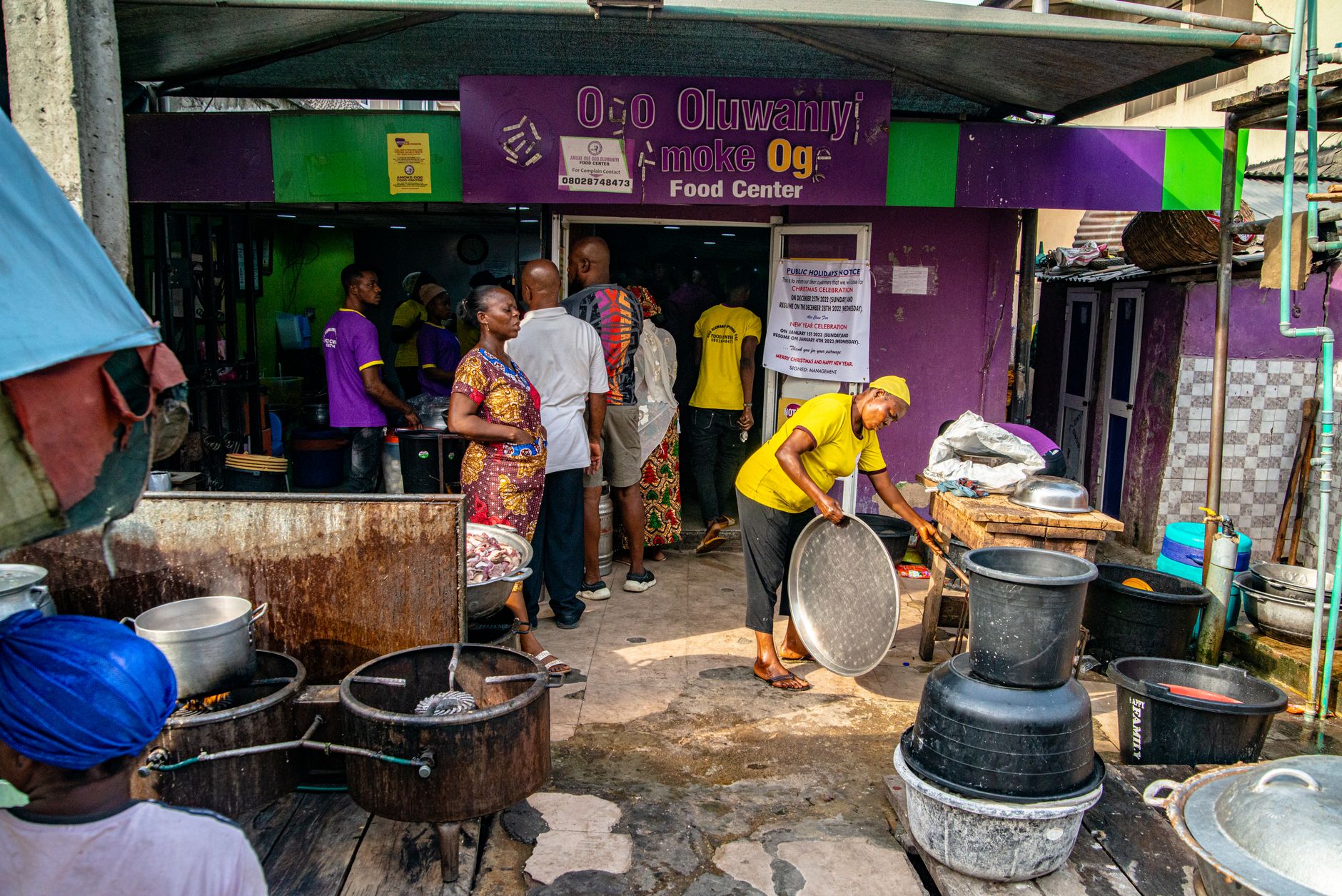
5. Manage the “Takeaway” Culture Gracefully
In Nigerian party culture, taking food home is a sign that the guest enjoyed the hospitality. However, this can be a major drain on your supplies. An unprepared host can find their post-party food stock entirely depleted by takeaway packs. You must plan for it.
First, have a designated “takeaway team.” This shouldn’t be the same staff serving the main buffet. Equip them with takeaway packs and instruct them to begin packing only after the majority of guests (say, 70-80%) have eaten. This ensures those still at the party have priority.
Second, set a portion limit for takeaways. The goal is a souvenir, not a full week’s shopping. A standard pack might contain one main, one protein, and one side. Instruct your team to stick to this. Communicating clearly with your caterer or kitchen staff about the takeaway strategy is vital. If they don’t know the plan, they can’t enforce it.
6. Prioritize the “Big Three”
If budget is a concern, focus your resources. At any Nigerian party, there are three things that absolutely cannot run out: Jollof rice, water, and some form of protein (usually chicken). Guests will forgive a lack of exotic salads or desserts, but an empty Jollof tray is a cardinal sin. An article exploring Nigerian food culture highlights how central Jollof is to celebrations. Allocate a disproportionate amount of your budget and planning to these three items. Ensure you have backups for your backups, especially for these.
The success of a Nigerian party’s catering isn’t measured by the variety of obscure dishes. It’s measured by the unrelenting availability of Jollof rice, chicken, and bottled water.
7. Conduct a Post-Mortem with Your Caterer
After the event, review what happened. Which food items were completely finished? Which ones had significant leftovers? This information is gold for your next event. A good caterer will track this. If they tell you the Small Chops were gone in an hour but the Efo Riro was barely touched, you know where to adjust your quantities for next time.
This data-driven approach removes emotion and guesswork from planning. For hosts of private parties, this feedback loop is how you refine your process from one event to the next, building a reputation for flawless execution. Discussing these details helps you understand consumption patterns specific to your social circle.
Troubleshooting Common Food Disasters
- Problem: More guests arrived than your buffer could handle.
* Solution: This is where your relationship with your caterer is key. A good caterer working in a place like Lagos will have emergency supply contacts. They can often arrange for a quick top-up of staples like rice or chicken from a trusted source. This is a last resort and will cost extra, but it can save the day.
- Problem: The buffet line is too long and slow, making people think food is scarce.
* Solution: Create multiple service points. Instead of one long buffet table, have two smaller, identical ones. Or, create stations: a station for rice dishes, a station for swallows, a station for proteins. This distributes the crowd and speeds up service dramatically.
- Problem: A specific popular item (e.g., Asun) finished almost instantly.
* Solution: For the next party, either double the quantity of that specific item or switch its serving style. As mentioned, moving it to a “cook-to-order” station can slow down consumption and make it feel more like a special treat.
By planning for these scenarios, you can turn a potential disaster into a minor hiccup.
FAQ
How much should I budget for food per person for a Nigerian party?
A simple buffet might be at the lower end, while a multi-course meal with live stations will be at the higher end. Always get detailed quotes from at least three caterers.
Is it better to use a venue’s in-house caterer or hire an external one?
Both have their merits. In-house caterers know the venue’s kitchen and logistics intimately, which can lead to smoother service. External caterers might offer more specialized menus or better pricing. If using an external caterer, ensure they visit the venue beforehand to inspect the facilities. Some venues, including ours in Lagos, offer flexibility and have preferred vendor lists.
What are the most important dishes to have at a Nigerian wedding?
Jollof rice is non-negotiable. Other staples include Fried Rice, a swallow (like Amala, Eba, or Pounded Yam) with appropriate soups (like Ewedu or Egusi), Moi Moi, and a variety of proteins like fried chicken, beef, and fish. Small Chops are also considered essential. A deep dive into Nigerian wedding traditions consistently shows food as a central element of the celebration.
How do I handle guests with dietary restrictions?
It’s becoming more common. Ask for dietary needs on your RSVP. The easiest way to cater for vegetarians or those with allergies is to have one or two dedicated dishes, like a vegetable stew or a simple grilled fish, kept separate from the main buffet to avoid cross-contamination.
When is the best time to serve food at a party?
For a typical evening event starting at, say, 6 PM, it’s good practice to have small chops and drinks available from the beginning. The main buffet can open around 7:30 or 8:00 PM, after the first couple of hours. This allows early guests to have a bite while waiting for the main event to kick off.