Is your event’s success riding on a spreadsheet and a prayer? An inaccurate headcount is more than a small headache; it’s a direct path to budget overruns, food waste, and a chaotic guest experience. To properly manage event RSVPs, you must choose a single, clear collection method, set a firm deadline with a built-in buffer, and automate your follow-up process for non-responders. This structured approach prevents last-minute scrambles and ensures your final numbers are as accurate as possible, directly impacting your budget and planning. By the end of this guide, you will have a step-by-step process for managing your event’s attendance list like a professional.
Prerequisites: What You Need Before You Start
Before you send out a single invitation, a little preparation goes a long way. Make sure you have the following sorted:
- A Finalised Guest List: This seems obvious, but your list should be complete, with correct names and contact details (email or phone number). Don’t start collecting RSVPs with a partial list.
- Your Event’s Core Details: Date, time, a clear description of the event, and the full venue address. For our venue, that would be Regal Castle, located on Ikotun-Idimu Road in Lagos.
- Your “RSVP By” Date: Decide on a firm deadline for responses. A good rule of thumb is 2-3 weeks before your event date. This gives you time to follow up and provide final numbers to vendors.
- A Budget for RSVP Management: Will you use a free tool like Google Forms or invest in a paid platform? Even free options can have “costs” in terms of your time.

Steps to Effectively Manage Your Event RSVPs

Follow these steps to create a smooth, efficient, and accurate RSVP process for any event, from a wedding to a corporate gala.
Step 1: Choose Your RSVP Method
Your first decision is how you will collect responses. Mixing methods (e.g., some people text, others email, a few call) is a recipe for disaster. Pick one channel and stick to it. Your main options are:
- Digital RSVP Platforms: Tools like Eventbrite, RSVPify, or even Nigeria’s own Tix.africa are built for this. They automate confirmations, send reminders, and can even process payments. This is the gold standard for most events. These platforms often provide real-time analytics on your response rate.
- Email with a Form Link: A cost-effective method is to email your invitations and link to a dedicated form. A Google Forms survey is a powerful, free tool that can collect names, plus-ones, meal preferences, and more, all neatly organized into a spreadsheet.
- Dedicated Wedding Website: For weddings, platforms like The Knot or Zola integrate RSVP management directly into the site where guests are already getting event details. It centralizes all information for them and for you.
- Physical Mail-in Cards: While traditional for formal weddings, this is the slowest and most labour-intensive method. It can be elegant, but you must manually track every response as it arrives. A 2019 survey found that only 24% of weddings used purely physical RSVPs, a number that has surely declined.
Step 2: Design a Clear and Simple Invitation
Your invitation, whether digital or physical, must be unambiguous. State clearly who is invited (e.g., “We have reserved two seats in your honour”), the event details, and how to RSVP.
Crucially, include:
- The RSVP Deadline: Display this prominently. Use clear language like, “Kindly reply by 15 August 2026.”
- The “How”: A direct link to your RSVP form or website. Don’t make them search for it. Use a URL shortener like Bitly to create a clean, memorable link if needed.
- Essential Questions: Only ask for what you absolutely need. Name, attendance confirmation (Yes/No), and perhaps meal preference. Every extra question you add reduces the completion rate.
Step 3: Send Your Invitations and Track Opens
Send your invitations in one go to ensure everyone has the same amount of time to respond. If you are using an email platform like Mailchimp or a dedicated RSVP tool, you can monitor open and click-through rates. This data is invaluable.
If you see that a large group of people haven’t even opened the email after 48 hours, it could signal a problem with your subject line or that the email went to spam. A simple subject line like “Invitation to [Your Event Name]” is often most effective.
An RSVP isn’t just a headcount. It is the first point of data in creating a personalized and high-quality guest experience.
For major events at Regal Castle, we always advise clients to consider a soft launch, sending to a small test group first to catch any broken links or confusing wording before the main send.
Step 4: Automate Reminders for Non-Responders
This is the most critical step for achieving an accurate headcount. People are busy and will forget. Do not take a non-response as a “No.” Most event platforms allow you to schedule automated reminder emails to be sent to anyone who hasn’t opened the invitation or hasn’t responded by a certain date.
Your reminder schedule could look like this:
- Reminder 1: One week before the RSVP deadline.
- Reminder 2 (The “Final” Call): 24-48 hours before the RSVP deadline. Use a subject line like, “Final Reminder: RSVP for [Event Name] closes tomorrow.”
The Impact of Follow-Ups
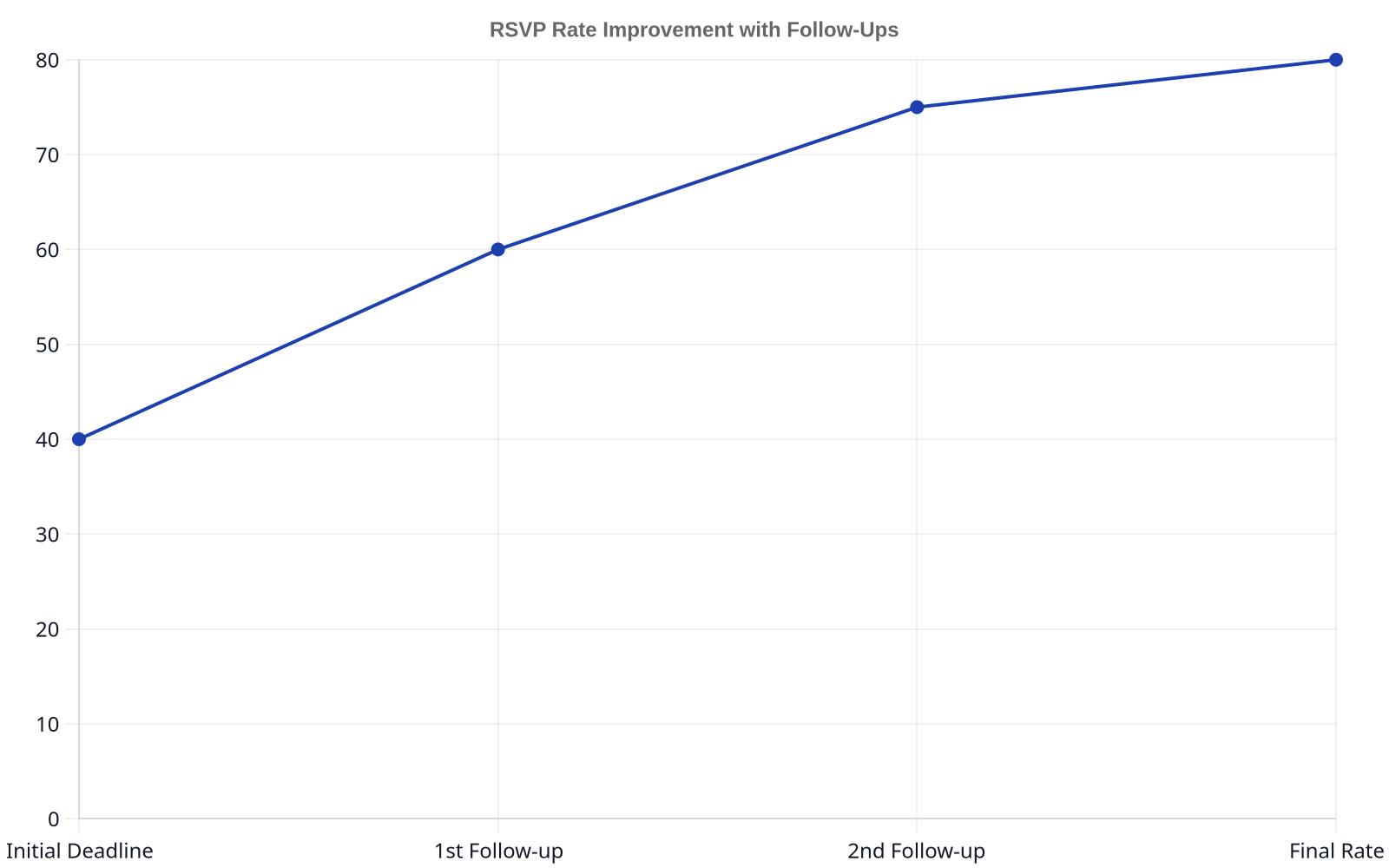
Never underestimate the power of a gentle nudge. A non-response is rarely a deliberate “no.” It is usually a result of a busy inbox. A well-timed follow-up is not pushy; it is helpful.

Step 5: Personally Follow Up with Key Guests
After your automated reminders have gone out and the deadline has passed, you will have a list of remaining non-responders. For critical guests (e.g., family, VIPs, key speakers), a personal touch is required. A direct phone call or a personal text message is often the quickest way to get a firm answer. This is where our Event Planning Assistance can be a lifesaver, as our team can handle these follow-ups on your behalf.
When you call, be direct and friendly: “Hi [Name], just following up on the invitation to [Event Name]. We need to provide final numbers to our caterers and hope you can make it. Can I mark you down as attending?”
Step 6: Close the RSVPs and Finalize Your List
Once your deadline passes and you have completed your follow-ups, officially close the RSVP form. This prevents stragglers from trickling in and changing your numbers. Update your master list with the final “Yes” and “No” counts.
This is the list you will use for everything going forward: creating seating charts, printing name tags, and providing final guaranteed numbers to your venue and caterer. Many venues, including ours, have vendor-friendly policies that make this coordination straightforward, but they all depend on a firm, final number.
Trying to manage RSVPs through WhatsApp messages and verbal confirmations is like trying to build a house without a blueprint. It guarantees cracks in the foundation.
Understanding RSVP Response Rates
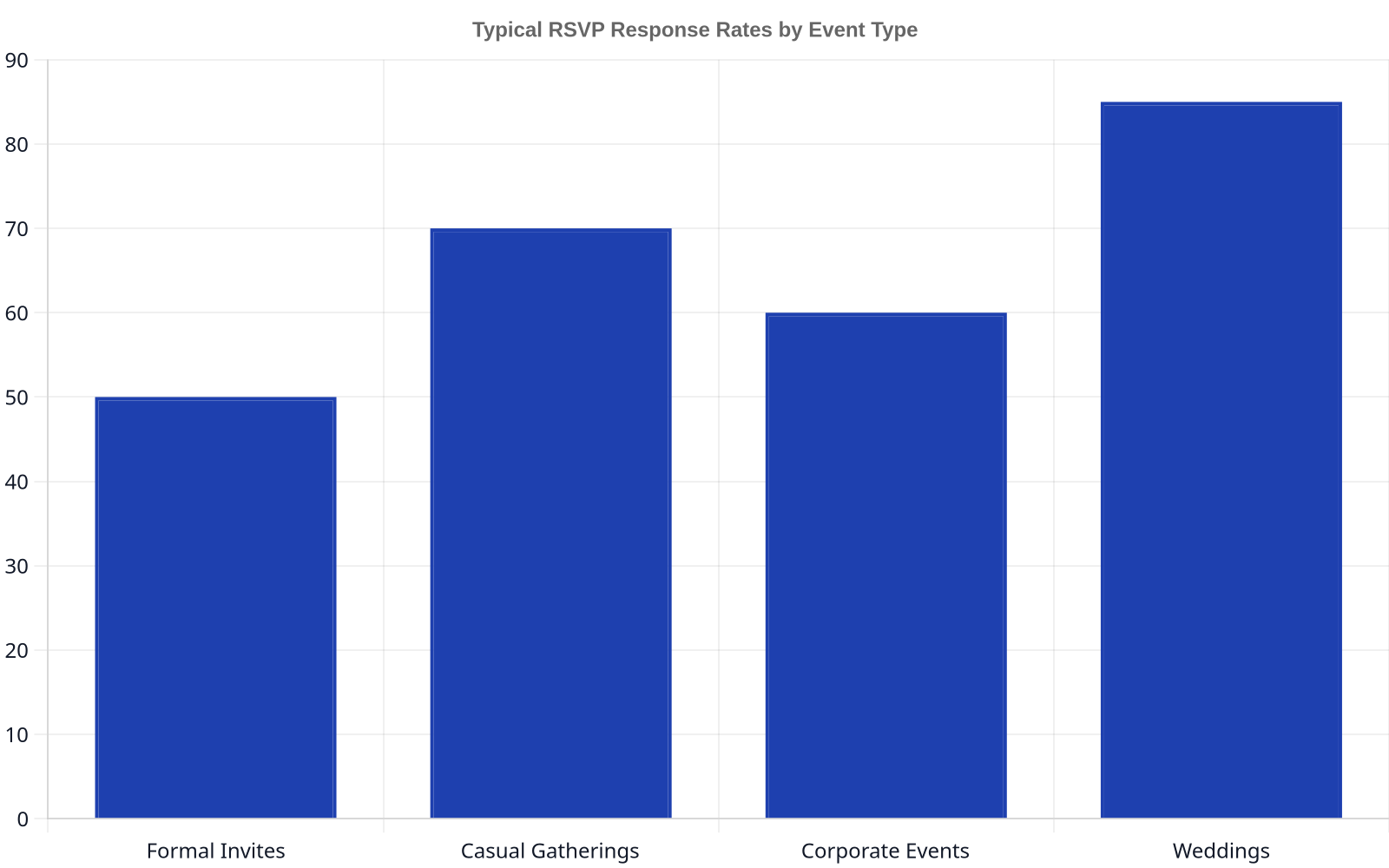
Setting realistic expectations for your RSVP responses is key to avoiding planning-related stress. Response rates are not uniform; they fluctuate significantly based on the nature of your event and your relationship with the guest list.
Step 7: Communicate the Final List to Vendors
Your caterer, rental company, and venue all rely on your final headcount. Provide them with the number of confirmed guests, usually broken down by adults, children, and any dietary restrictions you collected. Most vendors need this final count 7-14 days before the event, which is why we recommend setting your RSVP deadline 2-3 weeks out. A late or inaccurate count can result in extra fees. According to a survey by the National Association for Catering and Events (NACE), last-minute changes are a top stressor for 78% of caterers.
Troubleshooting Common RSVP Problems
- Problem: Guests RSVP for more people than invited.
* Solution: This is why your invitation wording is so important. If it happens, a polite but firm conversation is needed. You can say, “We’re so excited to celebrate with you! Unfortunately, our venue capacity is quite strict, so we are only able to accommodate the guests specifically named on the invitation.”
- Problem: A key guest hasn’t responded, even after follow-ups.
* Solution: Assume they are not attending. Plan your event based on confirmed responses only. If they show up unexpectedly, you will handle it, but you cannot base your budget and logistics on a “maybe.” For events with many out-of-town guests, having elegant Guest Suites on-site can simplify their planning and encourage a quicker RSVP.
- Problem: You are getting lots of “Maybe” responses.
* Solution: Do not offer a “Maybe” option on your RSVP form. The choices should be a binary “Will Attend” or “Will Not Attend.” If people write in “maybe” themselves, you need to follow up for a firm answer before your deadline.
Managing RSVPs is a foundational skill for any event organizer. Get it right, and the rest of your planning process becomes significantly smoother. By implementing a clear, structured system, you trade chaos and uncertainty for data and control, ensuring your event at Regal Castle or any venue is a resounding success.
Ready to start planning your next flawless event? Contact us to see how our venue and services can bring your vision to life on Ikotun-Idimu Road, Lagos.
FAQ
What is a good RSVP response rate for a wedding?
The rate is higher because of the personal connection. However, this assumes you have accurate contact information and are inviting guests who would genuinely want to attend.
How far in advance should you ask for RSVPs?
Send your invitations 6-8 weeks before the event, and set your RSVP deadline for 2-4 weeks before the event date. This provides enough time for guests to make arrangements and for you to follow up with non-responders before you need to give final numbers to your vendors.
How do you politely remind guests to RSVP?
Keep your reminder friendly and direct. A simple email or text saying, “Hi everyone, just a friendly reminder to please RSVP for [Event Name] by [Date] so we can get a final headcount. You can RSVP here: [Link]. We hope to see you there!” works perfectly. Most modern RSVP platforms can automate this for you.
Is it rude to call someone who hasn’t RSVP’d?
No, it is not rude, especially after the RSVP deadline has passed. A phone call is often the most effective way to get a direct answer. Frame it as a logistical necessity: “We’re finalizing numbers for the caterer and wanted to make sure we included you.”
Can I charge people who RSVP yes but don’t show up?
While tempting, it is generally not advisable to charge no-shows, as it can damage relationships. For ticketed or corporate events, the policy might be different and should be clearly stated upfront. For personal events like weddings, this is strongly discouraged. A better approach is to manage the RSVP process tightly to minimize no-shows in the first place.