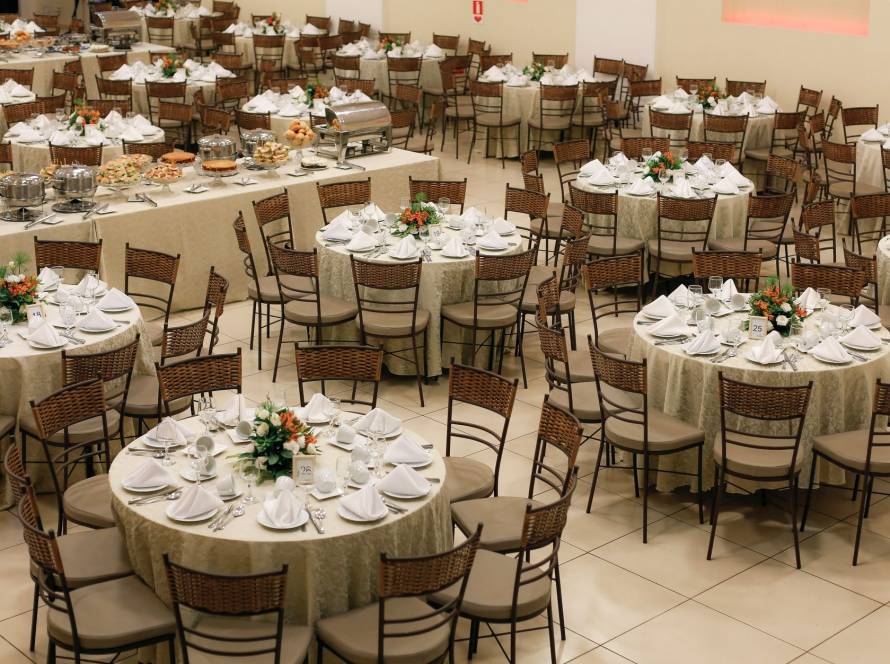
Finding an independent event centre that allows outside caterers means skipping hotel banquet halls with mandatory food packages and seeking standalone venues with flexible vendor policies. Securing this freedom matters because the menu defines a Nigerian wedding, and entrusting your jollof and amala to a venue’s unproven in-house kitchen risks steep markups, restricted portions, and severe social embarrassment.
Unbundle the Venue Rental from the Food Package
A seemingly cheaper room with an expensive food minimum frequently costs more overall than a higher-priced hall that separates the rental from the catering. AyeDu provides a wedding budget calculator that breaks down venue and food minimum trade-offs event by event to calculate the true total cost before signing a contract. Venues with tied in-house catering build their profit margins directly into the mandatory price-per-head for food and drinks.
You gain immediate negotiating power when you sever the venue rental from the menu supply. Bypassing tied in-house catering by sourcing competitive bids from external caterers yields food and beverage savings of up to 40%. This competition forces vendors to deliver better value than a single, non-negotiable in-house option. You control the exact quality of the party jollof, the size of the protein portions, and the variety of the soup station without paying the venue’s hidden markup.
This unbundling shifts your budget directly into guest hospitality rather than administrative overhead. Separated contracts let you allocate funds exactly where Nigerian guests expect them. An open catering policy makes the food a strategic choice of culture and celebration, rather than a fixed tax paid to the building owner.
Always ask venues for their external vendor guidelines before paying the initial deposit. Some halls claim to allow outside catering but impose a restricted vendor list, which limits your choices back to a handful of expensive providers. Securing true open-catering terms ensures you can hire the specific local cooks whose recipes your family prefers.
Model Your Independent Catering Costs
The risk of handling your own vendors is underestimating the sheer scale of the food bill, because initial caterer quotes rarely reflect the final number. ElitePlanners features an event cost calculator that estimates realistic food service budgets using active regional vendor pricing data across major Nigerian metropolitan markets. Base per-person catering rates for a primary reception meal range from ₦3,000 to ₦10,000.

Knowing this baseline helps you filter out caterers who bid too low to deliver quality, or charge premium island rates without the matching service. Expanding an external menu to include drinks, small chops, a cocktail station, and dessert elevates per-head costs to ₦7,000–₦14,000. You must model these additions early. Guests expect continuous service from the moment they arrive, and small chops bridge the gap while the main buffet lines form.
Build this budget before you tour any independent venues. The flexibility to choose your own vendors only works if you actually have the cash allocated to pay them. You need to confirm exactly how many guests your budget supports at ₦14,000 a head. This figure dictates whether you can invite 500 people or need to cap the guest list at 350.
Once you lock in the realistic catering cost, you know exactly what is left over for the venue rental fee itself. Tell your caterer to split their invoice into the main buffet and the supplemental stations, so you can cut the dessert bar if the hall rental costs more than anticipated.
Verify Layout Capacity and Back-of-House Space
You must physically check the service areas through an on-site assessment step requiring couples to inspect prep space, kitchen facilities, and staging zones for external caterers. A caterer cooking for hundreds of guests needs heavy-duty washing areas, safe generator connections for industrial warmers, and clear access corridors that bypass the main guest entrances. You ruin a great menu if the vendor has nowhere to plate the food or store backup coolers out of sight.
This demand for staging area forces a direct trade-off with your seating plan. A venue listed at 500-guest maximum capacity drops to approximately 350 seated guests once staging, dance floors, and buffet lines are configured. Venues advertise empty-room standing capacity, but a seated owambe requires wide aisles for servers and guests in voluminous traditional wear. You have to ask the hall management for the seating capacity under your specific banquet layout, rather than relying on the brochure number.

Independent venues designed for large crowds handle this constraint better than converted restaurants. Regal Castle operates a hall on Ikotun-Idimu Road in Lagos with a stated capacity of 500-1000 guests, and their flexible policies support unique event needs like multi-station buffets. They provide planning assistance and on-site guest rooms, including a bridal suite, which helps coordinate early vendor arrivals. Check the actual floor space yourself. Unbolt the service doors to measure the gaps; a standard single door slows down staff carrying massive coolers, while double doors let them move fast and keep the buffet stocked.
Audit Hall Rental Inclusions and Security Deposits
A venue that charges ₦1.2 million but includes tables, power, and security regularly proves cheaper than an ₦800,000 hall where every operational element is an add-on rental. You protect your budget through a contract verification protocol auditing hall hours, furniture supply, generator fueling, security personnel, cleaning fees, VAT, and overtime rates. The advertised rental price almost never covers everything. Missing one of these lines leaves you scrambling to pay diesel suppliers in cash while you should be taking family photographs.
This audit changes how you evaluate independent spaces. Halls that allow outside catering sometimes push the cleanup costs back onto you. You need to know exactly who sweeps the floor after the caterers pack up their coolers. If your event runs past the agreed time, the overtime rate kicks in immediately. Confirming these exact inclusions in writing stops the venue manager from shutting off the generator halfway through the after-party.
Damage policies represent another major hidden cost in external catering setups. Refundable post-event damage deposits required by hall operators range from ₦50,000 for smaller venues to ₦200,000 or more for large-capacity halls. Venues charge these caution fees to cover broken chairs, stained walls, or damage caused by your independent vendors dragging heavy equipment across the tiles.
This deposit ties up your working capital. You get it back after the event minus any damages, so you must instruct your caterers and decorators to move their gear carefully. Assign a trusted groomsman to walk through the hall with the facility manager before setup begins to photograph any existing scratches.
Time Your Booking for High-Demand Dates
The timing of your search dictates which venues will actually consider your vendor requests. An advance booking window requires venues to be secured 3 to 6 months before weekend wedding dates. Couples demanding the most competitive standalone event centres face even tighter timelines for prime slots. A high-demand Saturday booking window requires contracts to be finalized 12 to 18 months in advance in major markets.
Securing a hall this early implies you must commit to a space before you have hired your actual caterer. You lock in the building with an open vendor policy first, and then spend the following months tasting menus and negotiating with food suppliers. Popular halls in Lagos, Abuja, and Port Harcourt fill their weekend calendars rapidly, especially during the December owambe season. If you hesitate, you lose the independent venues and get forced into hotel banquet rooms that mandate their own rigid food packages.
You regain control by staying flexible on the calendar. Settling on two or three acceptable dates before you tour a single venue gives you room to negotiate. Off-season months or weekday weddings open up availability at the best independent halls. Venue operators negotiate harder on mid-week dates because those rooms otherwise sit empty.
This date flexibility remains the most powerful cost lever in venue selection, letting you secure a premium hall with an open catering policy without paying the peak Saturday premium. Never print your physical invitations until the hall manager signs your specific date into their ledger.
Frequently Asked Questions
What is a corkage fee?
A corkage fee is a flat charge a venue levies per bottle or per head to allow you to bring your own alcohol onto the premises. It depends on the venue’s primary business model: hotels almost always charge steep corkage to protect their bar profits, while standalone event halls frequently waive it entirely or charge a nominal cleanup fee. Check your contract to see if this covers chilling the drinks and providing glassware.
Can I bring my own drinks, too?
Yes, independent venues with open catering policies usually allow you to supply your own drinks. You will need to hire a separate drinks vendor to provide coolers, ice, and service staff to manage the distribution. Sourcing your own beverages from major wholesale markets dramatically cuts down the per-bottle cost compared to a venue’s marked-up bar menu.
Are there hygiene standards my caterer must meet?
Venue managers require your independent caterers to clean their service areas and safely manage their waste before leaving the premises. Many established event halls will ask to see your caterer’s previous work or business registration to ensure they operate professionally. The venue wants to protect its floors and plumbing from dumped oil or food debris.
Does a venue without catering restrictions cost more to rent?
The base rental fee often appears higher because the venue owner makes no back-end profit from food markups. They have to cover their entire operating cost and profit margin from the room hire alone. You still save money overall because external caterers charge far less for the actual meal service than an in-house kitchen’s mandatory package.
What happens to leftover food?
Your independent caterer packs up the unserved food into coolers and hands it over to your designated family representatives at the end of the event. You must explicitly assign an elder or trusted family member to supervise this handover before the party ends. Venues take no responsibility for external food storage once the reception concludes.